8 out of 10 people will read the headline. Only 2 out of 10 will read the rest of the text. This David Ogilvy statistic from 1963 hasn't changed despite 60 years of marketing revolutions. The headline is 80% of the success of every ad, every post, every campaign.
In 2026, with Instagram feeds scrolling past 300 posts per day, Google showing AI results above organic links, and Facebook using Advantage+ AI to auto-rotate creative, the headline matters more than ever. You're fighting for 1.5 seconds of attention, and there's no room for generic headlines.
This guide won't repeat clichés like 'add numbers' or 'use power words'. We'll go deep into the psychology of what makes a person stop and read, cover real formulas proven in research, and show how to test headlines properly before the campaign blows up or falls flat.
The PAS Formula: Why It Still Works
PAS, short for Problem-Agitate-Solution, is the oldest formula in copywriting and still the most effective. The reason is psychological, it starts with the customer's existing situation (Problem), amplifies the pain (Agitate), and then offers a Solution. This mental journey makes a person identify before they start thinking.
Example: 'You're not ranking on Google. Every passing day your competitors climb above you, and you've lost another 50 potential customers. Why not fix this week?'
This structure works because it's about the person and their reality, not about your product. Most bad headlines I see start with 'We offer' or 'The leading solution'. Nobody wants to read that. People want to read about themselves.
AIDA Formula: Still Relevant or Outdated?
AIDA (Attention-Interest-Desire-Action) was developed in 1898 by Elias St. Elmo Lewis. It still works, but it's become predictable. If the audience recognizes the pattern, it loses its power.
Smart use in 2026: use AIDA as a working plan, not a template. Make sure the headline grabs attention, sparks interest, and offers enough to lead to action, without sounding like a 1950s ad.
Data-Backed Headlines: Why Numbers Work
A 2014 Conductor study tested 3.3 million headlines and found headlines with numbers get 36% more clicks. The reason: numbers create specificity and a clear promise. '7 ways to grow sales' promises something concrete, 'ways to grow sales' doesn't.
What works better:
Odd numbers outperform even numbers (don't feel rounded). 7, 9, 11 beat 6, 8, 10.
Larger numbers create more credibility (37 tips sounds more professional than 7).
Percentages work great in outcome promises ('We grew ROAS by 43% in two months').
Numbers at the start of the headline, not the middle, the eye is drawn to the start of the line.

Curiosity Psychology: The Curiosity Gap
The Curiosity Gap is a research-backed technique by Professor George Loewenstein from 1994. The idea: you create a headline hinting at important information without fully revealing it. Our brains can't tolerate missing information and push us to click.
Examples that work: 'This mistake costs US businesses $100,000 a year' (which mistake?), 'The real reason your campaign isn't working' (what reason?), 'We hit 1,000 customers without advertising, and here's how' (how?).
Important warning: clickbait fails in 2026. If the headline promises value and the content doesn't deliver, Bounce Rate spikes, time-on-page drops, and Google penalizes you. The rule: curiosity must be tied to real value waiting inside.
Power Words: A Research-Backed List
BuzzSumo analyzed 100 million headlines and identified words appearing in headlines with the most shares. Here are the categories that work:
Urgency words: today, now, immediately, this week, before you miss out. Create time pressure, important not to fake.
Novelty words: new, updated, 2026, revolutionary, innovative. Push against 'same old'.
Value words: free, gift, bonus, savings, ROI. Direct to the wallet.
Authority words: experts, research shows, proven, validated, secret. Build credibility.
Emotion words: amazing, simple, stunning, terrifying, mind-blowing. Trigger response.
Warning: overuse of all these turns headlines cheap and cliché. Use sparingly.
Facebook vs Instagram Headlines: The Real Differences
Facebook gives the headline a stronger role, it's prominent in the ad, weighted by the algorithm. On Instagram, the visual is king, and the 'headline' is actually the first line of copy before 'See More'.
Facebook headlines that work in 2026: 5-7 words, starting with a number or question, stating a clear benefit. Example: 'We dropped cost per lead by 45% without changing budget'.
Instagram headlines that work: the first line must prompt the reader to keep reading (Pattern Interrupt). Example: 'Stop, this isn't another marketing post'. Or: 'Business owner? You're losing money in 3 places, here's where'.
Google Ads Headlines: Speaking the Searcher's Language
A Google ad appears to someone who just searched for something specific. The headline must reflect the search. Using Dynamic Keyword Insertion (DKI) allows inserting the exact search keyword into the ad. This boosts CTR by 7-15% in Google's research.
Optimal structure per Google's 2026 recommendations (Responsive Search Ads): 15 different headlines at 30 characters each, 4 descriptions at 90 characters. Google AI picks the best combination per search. The common mistake: uploading 5 headlines instead of 15, limiting the algorithm.
Tricks that work: direct question ('Need website accessibility?'), brand + benefit ('Acme, sites that sell'), specific price offer ('Brand site from $499').
A/B Testing Headlines: How to Do It Right
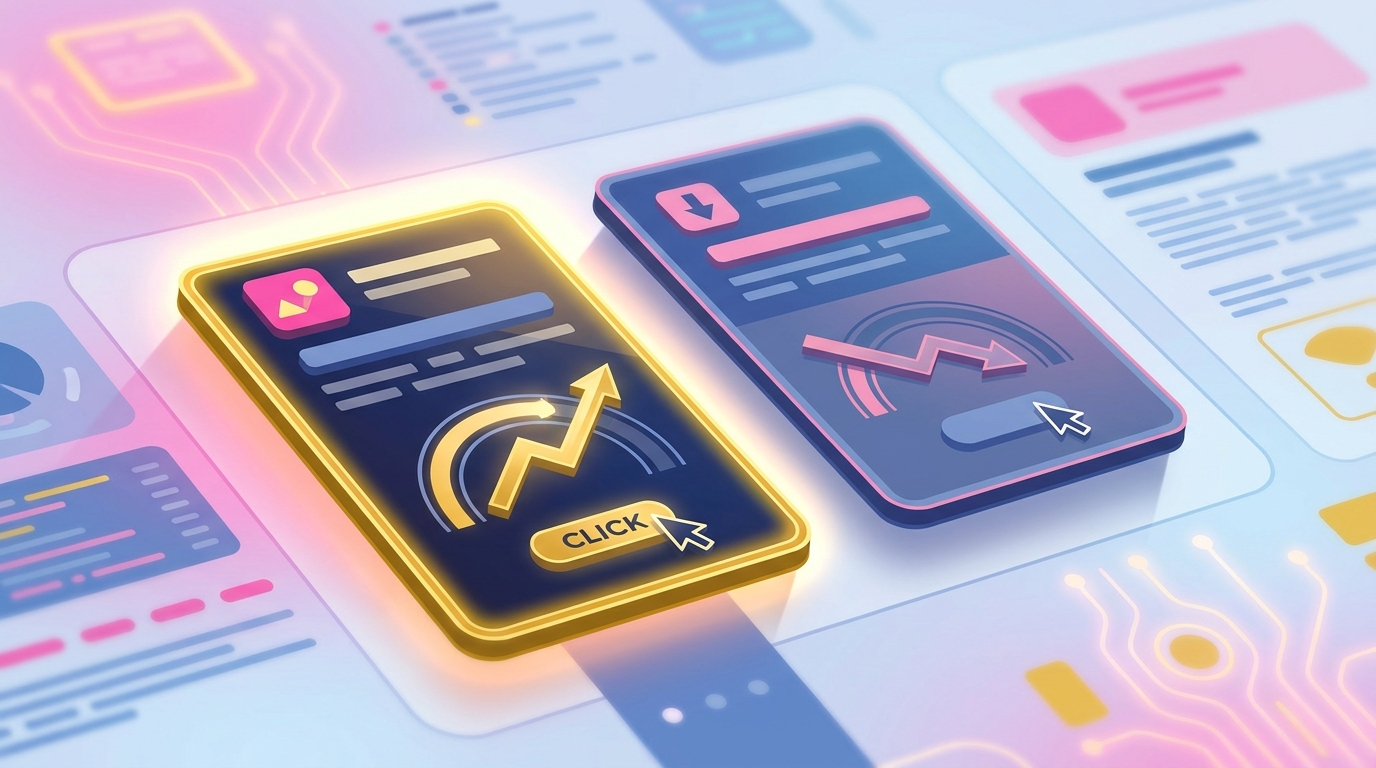
Every campaign deserves A/B testing. But most businesses do it wrong and stop the test too early. The basic rules:
Run at least two variations simultaneously, same budget, same targeting.
Test only one variable per test (headline, not headline + image).
Wait until each variation gets at least 100 clicks or 1,000 impressions (Statistical Significance).
Use a Statistical Significance Calculator (free, many online) to verify the result isn't random.
Don't stop the moment one leads, wait at least 7 days, because there's daily seasonality.
AI as a Headline Helper: Capabilities and Limits
ChatGPT, Claude and Gemini can generate 20 headline variations in a minute. This changes the game. But there's a real limit: AI repeats patterns it saw in training, so its headlines are predictable.
The right use: use AI for initial brainstorming, not as the final writer. Give it a detailed brief, target audience, pain points, and tone, and get 30 variations. Pick the best 5 and edit them manually for your brand voice.
Example prompt that works well: 'I'm advertising service [X] to an audience of [Y]. Their main pain is [Z]. Write me 15 Facebook headlines 5-8 words long, half in PAS formula and half with Curiosity Gap. Use natural English, avoid words like 'revolutionary'.'.
Mistakes That Still Echo Today
1. Headlines about you, not them: 'We're the leading agency' doesn't interest anyone. 'Our clients see 3x ROAS' interests because it promises a result.
2. Questions with obvious answers: 'Want to grow sales?' Yes, everyone. This headline doesn't qualify or offer anything. Questions should be specific: 'Can you afford 100 leads a month at $5 per lead?'.
3. Superlative overload: 'The best solution, the cheapest, the fastest'. No credibility, sounds like spam.
4. Promises you can't keep: 'Make $100,000 a month' if you can't prove it, you lose trust permanently.
5. Mismatch between headline and content: a strong headline leading to an unrelated landing page causes 80% Bounce Rate and damages Google Quality Score.
Headlines by Funnel Stage
The same headline doesn't work at every stage. In the Awareness stage, the audience doesn't know you and doesn't know there's a problem. Headlines must be educational and curiosity-driven. 'The real reason a website doesn't bring customers' works.
In the Consideration stage, the audience is aware of the problem and looking for a solution. Headlines can be more direct. '5 criteria you must check when choosing an SEO provider' works.
In the Decision stage, the audience is ready to buy. Headlines offer a clear choice. 'Acme, websites from $1,500 with 12 months of maintenance' works.
Common mistake: running a 'buy now' headline to an audience that isn't yet aware of the pain. The campaign fails and you blame the platform instead of the mismatch.
Conclusion: A Headline is the Result of Thought, Not Inspiration
A winning headline doesn't fall from the sky. It's the result of understanding the audience, their pain, the language they use, and the promise you can keep. Business owners trying to invent a 'winning headline' without this foundation are wasting time.
The practical process: interview 5 current customers (literally, over the phone). Document the exact words they use to describe their problem. Use those words in your headlines. This works 3x better than AI because these are the words the audience actually speaks.
Build a headline bank. 50 headlines that worked in past campaigns of yours or others in your field. When a new campaign comes, don't start from scratch, start from the bank and adapt. Over time, the headline bank becomes a marketing asset worth real money.